Purpose
This is one worked example, showing how OCOM's Core Characteristics (defined in Meta/Object.md) apply together to a single, deliberately ordinary domain: a library lending books to patrons. It exists to answer one question in under ten minutes: "what does it actually look like when OCOM is applied to something?"
This document is Informative, not normative. It introduces no new concept, defines no new type, and adds no requirement. Every characteristic it demonstrates is illustrated with example values, not prescribed ones — nothing here is a schema, and nothing here should be read as OCOM's own definition of anything. Where this example says less than, or differs in emphasis from, the normative sources it cites, the normative sources prevail — the same rule Examples/Overview.md's own Conformance section states for the Examples/ directory.
The Domain
A library lends physical items (books, journals, media) to registered patrons. This domain was chosen deliberately for being familiar without requiring any industry expertise, and for not being any organization's real business — see Governance/ADR-Candidates.md#cand-010 for why a domain-neutral example was required.
Two Objects participate: a Patron and an Item. What connects them is a Relationship, not a hierarchy.
Identity
Every Object requires Identity (Meta/Identity.md) — something that uniquely identifies it and remains unchanged through its Lifecycle.
- Patron:
P-10432— assigned once, at registration, never reused. - Item:
LIB-000198— an accession number, assigned once per physical copy, distinct from the title itself (two copies of the same book are two Items, two Identities).
Ownership
Every Object supports Ownership (Meta/Object.md lists Ownership among an Object's Core Characteristics but states it as should, not shall; Meta/Ownership.md says where applicable; the divergence is open as AO-015), which itself requires an Identifier, an Owner, an Owned Object, a Responsibility Scope, and an Effective Date.
- Identifier:
OWN-LIB-000198. - Owner: the library's Riverside Branch.
- Owned Object: Item
LIB-000198. - Responsibility Scope: the branch is accountable for the Item's condition and availability, not for how the Patron uses it once borrowed.
- Effective Date: the date the branch's copy entered circulation, e.g.
2024-03-11.
Ownership answers who is accountable for this Object. It does not answer who currently possesses it — that's what the Relationship below is for.
Relationship
Every Object supports Relationships (Meta/Object.md, "support relationships"), each of which requires an Identifier, a Source Object, a Target Object, and a Relationship Type.
- Identifier:
LOAN-2026-08-0431. - Source Object: Patron
P-10432. - Target Object: Item
LIB-000198. - Relationship Type:
Borrows.
This is the entire structural shape of a loan: one Relationship record connecting two Objects. Nothing about a due date, a fine, or a renewal is required by Relationship.md itself — those would be illustrative, optional fields (Relationship.md's own "may additionally define": Validity Period, Status, Constraints), not shown here to keep the example to what's actually required.
Lifecycle
Meta/Object.md names Lifecycle as one of every Object's seven Core Characteristics. The normative structure of what a Lifecycle actually consists of is defined separately, in Models/Lifecycle.md — which describes it at the Entity level (its own text speaks only of "Entity," e.g. "Every Entity shall have exactly one Lifecycle"), not as an independent Object-level definition. This example follows Meta/Object.md's characteristic and borrows Models/Lifecycle.md's structural shape (one initial State, one or more operational States, defined Transitions, optional terminal States) without claiming that document itself makes any statement about Object in general.
Item LIB-000198's Lifecycle, illustrated:
Available → On Loan → Returned → Available
                 ↘ Overdue → Returned → Available
                 ↘ Lost / Withdrawn
These state names are illustrative, not a normative enumeration — Models/Lifecycle.md defines the structural rules a Lifecycle must satisfy (an initial State, permitted Transitions, optional terminal States), not a fixed list of state names for any particular kind of thing, and this example does not invent one on the specification's behalf.
Metadata and Classification
Every Object contains Metadata (Meta/Object.md says shall, Meta/Metadata.md says may; the divergence is open as AO-022). Every Object may be classified (Meta/Object.md lists Classification among an Object's Core Characteristics and states it as may).
- Item Metadata (descriptive): title, author, edition.
- Item Classification:
Book— distinguishing it fromJournalorMedia, the library's other Item types.
What This Example Does Not Show
Two concepts are absent from this example, deliberately, and for two different reasons:
Governance is one of Object's seven Core Characteristics (Meta/Object.md) — required, not optional. It is not demonstrated here because no OCOM document defines what Governance means as a per-Object characteristic (distinct from docs/Governance/, which governs the specification itself). This is a real, open gap in OCOM, not something this example can honestly fill in. It is recorded as Governance/Architecture-Observations.md, AO-023; no ADR Candidate records it.
Evidence is not one of Object's Core Characteristics at all, and its absence here is a different kind of fact than Governance's. It is a Constitution-level principle (Core/Constitution.md, Principle 3) and a Memory-tier concept (Memory/Evidence Overlay.md), a different document layer than the one this example illustrates — there is nothing missing here to fill in.
Neither is a limitation of the library domain specifically — the same two facts hold for any Object this example could have chosen.
Status of This Example
Illustrative only. Conformance to OCOM is determined exclusively by the normative Specification, never by this document — the same principle Examples/Overview.md states for its own examples. This example does not constitute a Reference Implementation and makes no Conformance claim.
Try This on Your Own Model
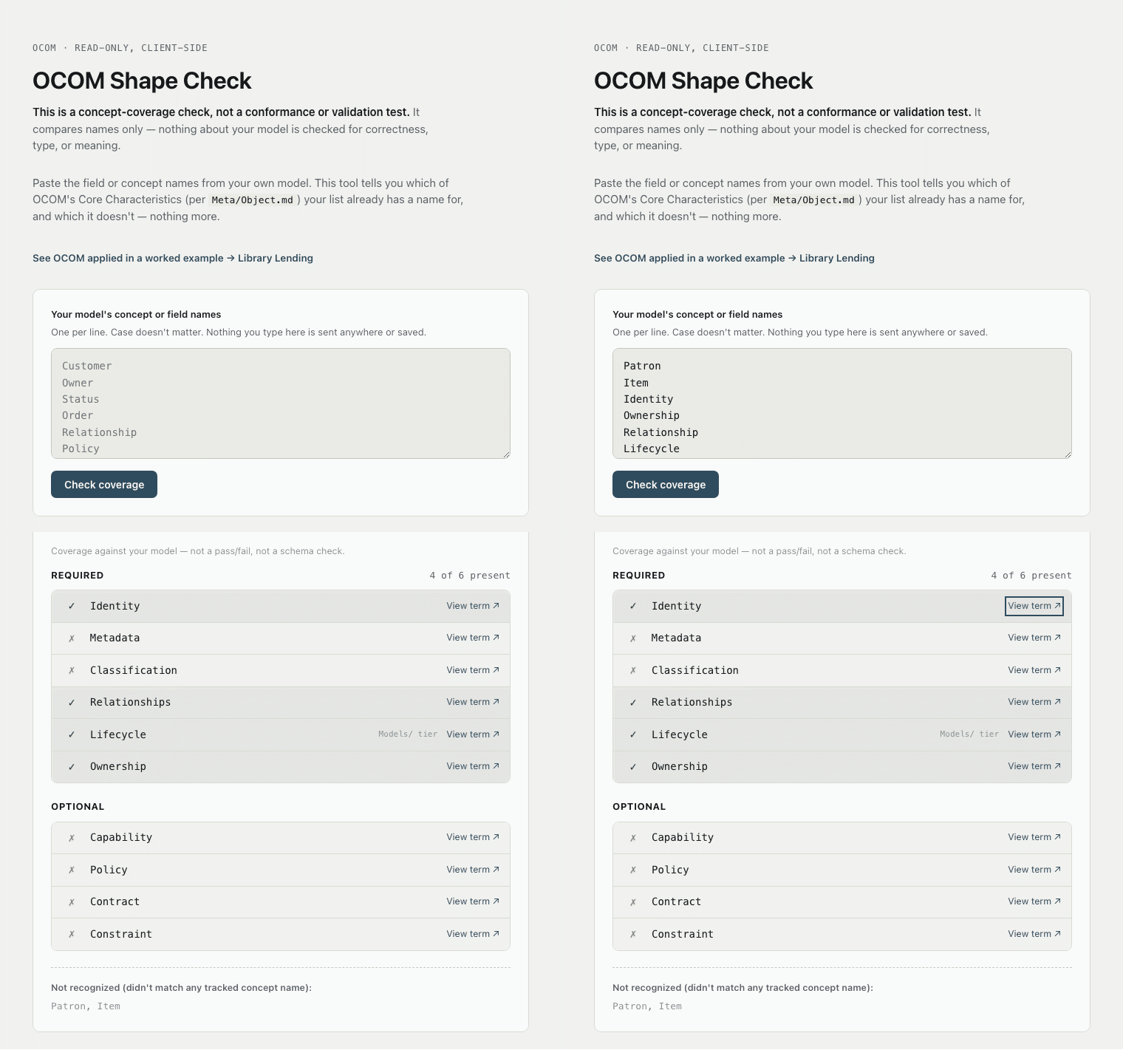
Try OCOM on your own model → Shape Check
A separate, read-only tool: paste your own model's field names and see which of the Core Characteristics above it already has a name for. It is not part of this Specification and not a validator; it is authorized and governed as a Consumer Tool by ADR Candidate CAND-013 (Decided, 21 August 2026). See the tool's own page for exactly what it checks and doesn't.
See OCOM Shape Check in action
Try it yourself → Shape Check
Run a First Pilot
Try OCOM on your own team → First Pilot